
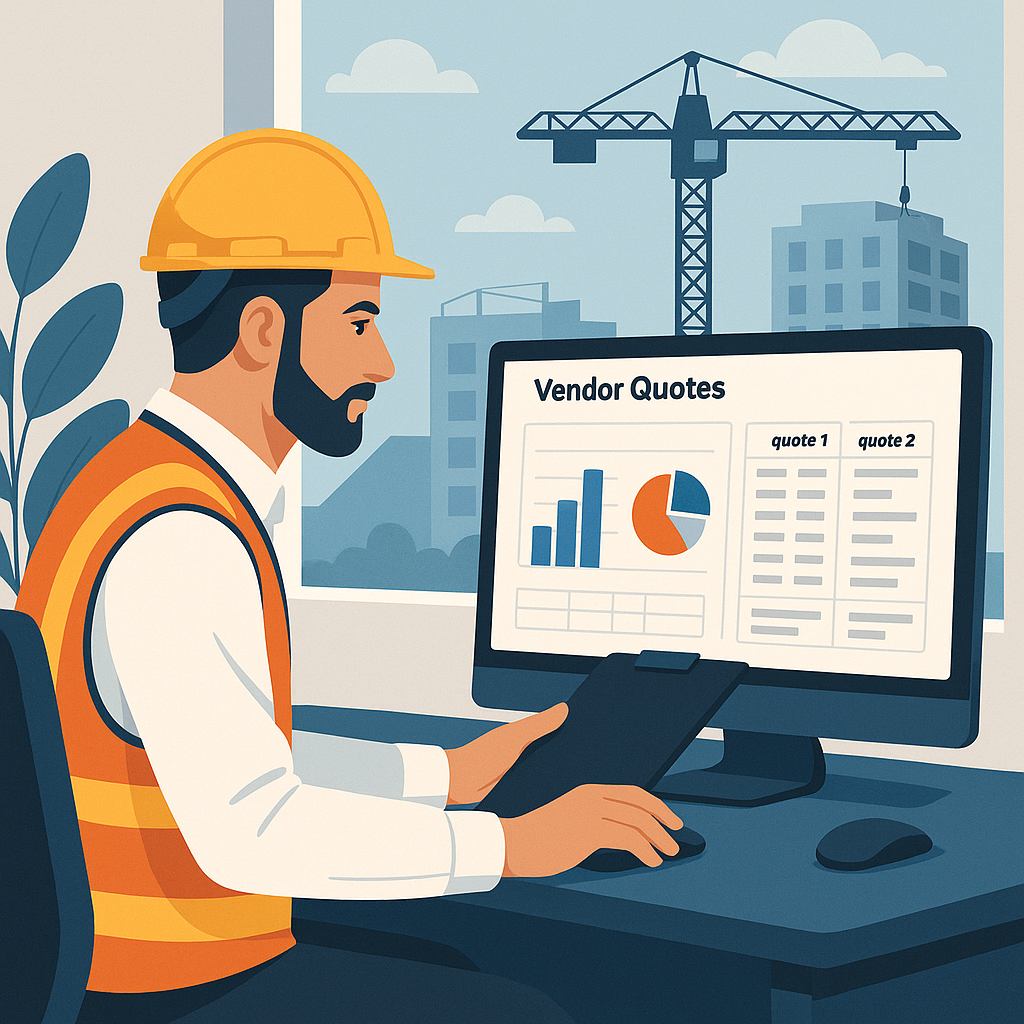
Why Quote Comparison is the Silent Killer of Margins
Ever had a project where the margins mysteriously vanished? You nailed the estimate, secured the project, and kept your team on budget — but somehow, you still ended up in the red. Odds are, the problem started with your vendor selection process.
Quote comparison is one of the most overlooked steps in construction procurement. It’s also one of the easiest ways to either protect or destroy your margins. Why? Because the lowest quote (L1) isn’t always the cheapest.
Let me explain.
The L1 Trap: Why Cheaper Isn't Always Better
It’s tempting to pick the cheapest quote and move on. After all, you’re under pressure to keep costs down and win bids. But here’s the thing: the lowest quote often comes with hidden risks.
Let’s unpack this with a common scenario. A contractor might accept the lowest bid for a key material, such as steel supply. On paper, it feels like a smart choice. But midway through the project, the vendor might start missing delivery deadlines or fail to meet quality standards. The contractor is then forced to source emergency materials at inflated prices, juggling delays and penalties. What seemed like a low-cost option quickly snowballs into lost margins and project overruns.
This isn’t just anecdotal. Industry studies consistently show that prioritizing upfront cost over total cost of ownership (TCO) leads to long-term losses. The lowest quote might save you money today but cost you more in the end.
So, how do you avoid this trap? It starts with a structured, detailed approach to quote comparison.
A Practical Workflow for Quote Comparison
1. Start with a Detailed Material Requisition (MR)
Before you even ask for quotes, ensure your Material Requisition (MR) is crystal clear. This document should include:
- Specifications: Define exactly what you need — size, grade, and any technical requirements.
- Quantities: Be precise. Over- or under-ordering can throw your budget off.
- Delivery timelines: Specify when you need the materials to avoid delays.
A detailed MR ensures vendors know exactly what you require, minimizing ambiguity and simplifying comparisons later.
2. Use RFQs to Standardize Vendor Offers
Send out a Request for Quotation (RFQ) to multiple vendors — but don’t just ask for prices. Request a complete breakdown, including:
- Unit price
- Taxes (GST)
- Freight charges
- Delivery timelines
- Payment terms
- Warranty or replacement policies
Structured RFQs force vendors to provide consistent data, making it easier for you to compare quotes in detail. Software tools like ProjectsNext can automate this process, reducing errors and saving time. If you’re still relying on email and spreadsheets, you’re leaving room for mistakes.
3. Analyze the Data, Not Just the Numbers
This is where most teams go wrong. They focus solely on the numbers without considering the broader implications. Use a comparison table to weigh all factors:
| Vendor Name | Unit Price (₹) | Freight (₹) | GST (%) | Delivery Time | Payment Terms | Warranty | Total Cost (₹) |
|---|---|---|---|---|---|---|---|
| Vendor A | 48,000 | 5,000 | 18% | 10 days | 30 days credit | 1 year | 63,640 |
| Vendor B | 45,000 | 8,000 | 18% | 15 days | Advance | None | 62,100 |
| Vendor C | 50,000 | 4,000 | 18% | 7 days | 45 days credit | 2 years | 63,720 |
Illustrative example — not real data
At first glance, Vendor B appears to be the cheapest option. But they require an advance payment and offer no warranty. If something goes wrong, you’re on your own. Vendor C, on the other hand, offers faster delivery and a 2-year warranty. That extra ₹1,620 might save you significantly in the long run.
4. Involve the Right Stakeholders
Don’t make this a solo decision. Bring in your project manager, site engineer, and procurement head. Each stakeholder has unique insights — the site engineer might flag quality concerns, while the procurement head might know about past vendor performance.
5. Document Everything
This step is non-negotiable. Keep a full audit trail of your RFQs, vendor responses, and your final decision. It protects you if disputes arise and helps you build a database of vendor performance for future projects.
Common Mistakes to Avoid
-
Skipping Freight and GST: That ‘cheap’ unit price might balloon after adding freight charges and taxes. Always calculate the total landed cost.
-
Ignoring Payment Terms: Cash flow is critical in construction projects. If a vendor demands full advance payment, you could face liquidity issues.
-
Trusting Verbal Promises: If a vendor says, “Don’t worry, we’ll deliver in 7 days,” get it in writing. Better yet, choose someone who backs their promises with documented commitments.
-
Neglecting Vendor History: Past performance is the best predictor of future reliability. If you don’t track this, you’re gambling with your margins.
FAQ
1. How many quotes should I collect?
Aim for at least three. Fewer than three won’t give you enough context to make an informed decision. If you go beyond five, the comparison process can become overwhelming unless you’re using dedicated software.
2. How do I handle vendors who don’t provide complete details?
Push back firmly. A vendor who can’t provide detailed breakdowns during the RFQ stage is unlikely to deliver structured service during the project. Use a standardized RFQ template to make compliance easier.
3. What if the cheapest quote is from a new vendor?
Exercise caution. Ask for references, review certifications, or start with a smaller trial order to test reliability before committing to a larger scope.
4. How can I ensure transparency in vendor selection?
Document every step, from the MR to the final purchase order (PO). Software tools like ProjectsNext can simplify this process by maintaining an organized audit trail.
5. Should I always avoid the lowest bid?
Not necessarily. The lowest bid isn’t inherently bad, but it should meet all criteria — reliability, quality, payment terms, and warranty — before being considered.
Comparison Table: Key Factors to Evaluate Vendor Quotes
| Factor | Why It Matters | Actionable Step |
|---|---|---|
| Total Cost | Includes unit price, freight, taxes | Calculate all-inclusive landed cost |
| Delivery Time | Impacts project scheduling | Verify vendor’s track record of timely delivery |
| Warranty | Protects against defective materials | Prefer vendors offering longer warranties |
| Payment Terms | Affects cash flow | Choose terms that align with your budget |
| Vendor History | Predicts reliability | Check references, past performance |
The Bottom Line
Quote comparison isn’t just about picking the lowest bid. It’s about balancing cost, quality, and reliability to protect your margins. A structured RFQ workflow helps you avoid the L1 trap and make smarter decisions.
If you’re tired of juggling manual processes, tools like ProjectsNext can streamline your procurement workflows. Get started free →
Learn more at JobNext.ai - Construction ERP