
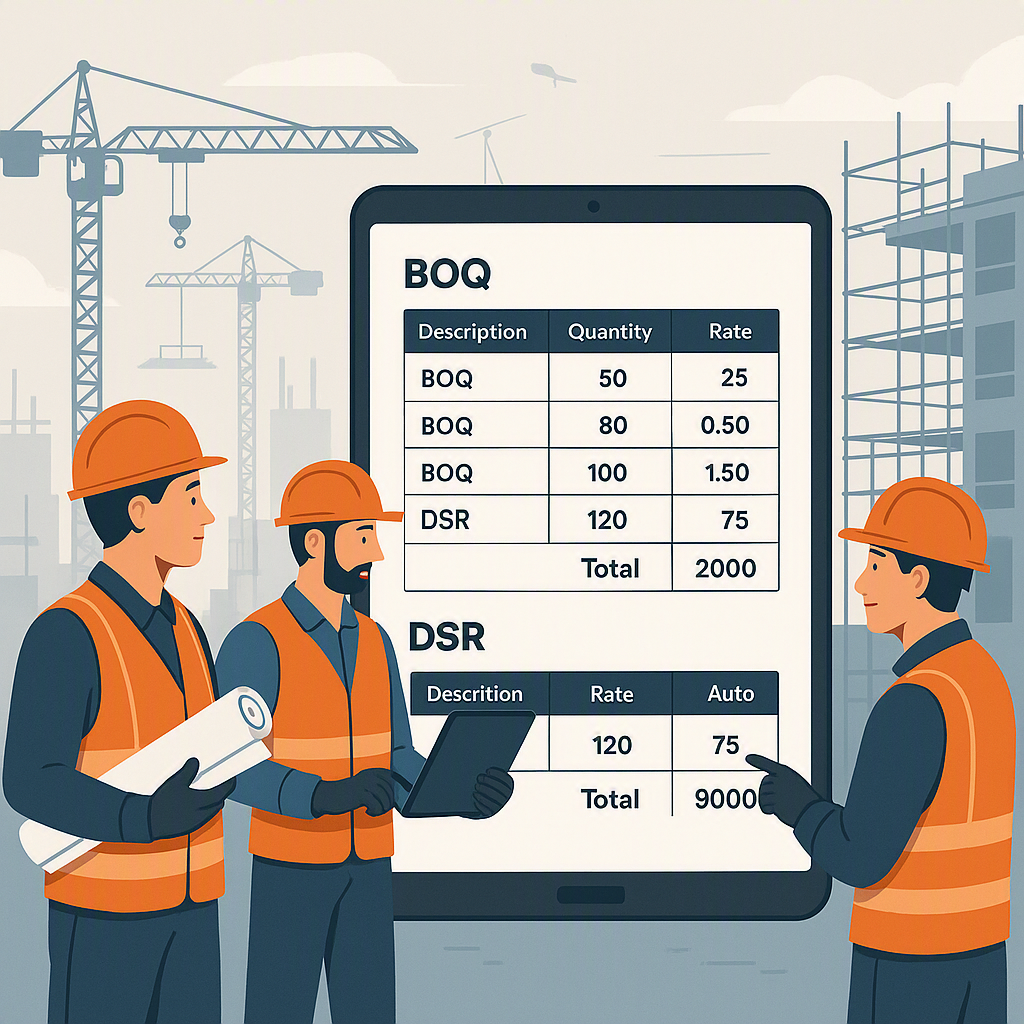
Why DSR-Based Estimates Often Go Wrong
Using CPWD DSR (Central Public Works Department Schedule of Rates) as a baseline for construction estimates is common practice. It’s standardized, detailed, and widely used in India. However, DSR doesn’t account for project-specific deviations. Factors like site conditions, material availability, or subcontractor inefficiencies can lead to significant cost variations from the initial estimate.
To address this, it’s essential to combine DSR rates with real-world inputs such as local market prices and project-specific adjustments.
The Key to Accurate DSR-Based Estimates: Layered Rate Analysis
Layered rate analysis can help improve the accuracy of DSR-based estimates. Here’s how:
- Start with CPWD DSR rates: Use them as your baseline for standard labor and material costs.
- Adjust for site-specific factors: Add markups for transportation costs, regional labor rates, and material availability. For example, steel prices may vary significantly between urban and rural areas.
- Incorporate project-specific risks: Account for contingencies like weather delays or subcontractor inefficiencies. This step is often overlooked but is critical to maintaining project margins.
Many teams perform this process manually using spreadsheets and market indices. However, structured workflows within construction management tools can streamline the process and reduce errors.
A Workflow Example: Using Technology for DSR-Based Estimates
Illustrative example — Here’s how a construction management tool could streamline DSR-based estimates:
- Import the BOQ: Upload the Bill of Quantities (BOQ) into the system.
- Apply DSR rates: Link each BOQ line item to the relevant DSR rate. Automating this step can save significant time.
- Adjust for market rates: Input current market prices for materials and labor to refine the estimate.
- Factor in contingencies: Allocate a percentage for risks like weather delays or unexpected costs.
- Generate the estimate: Compile all data into a detailed report for client approval.
This structured approach minimizes guesswork and reduces the time required for creating accurate estimates.
Common Mistakes When Using DSR Rates
- Skipping market adjustments: DSR rates may not always reflect current market conditions. Always cross-check with up-to-date market data.
- Ignoring site-specific costs: Transportation, labor availability, and local taxes can vary significantly by region.
- Underestimating contingencies: Projects rarely go exactly as planned. Always include a buffer for unforeseen circumstances.
- Relying on manual workflows: Using spreadsheets increases the risk of errors. Consider adopting construction management tools to streamline the process.
FAQ: DSR-Based Estimates
Q: How often are DSR rates updated?
A: DSR rates are updated periodically, but they may not always reflect real-time market fluctuations. It’s important to supplement them with current market data.
Q: Can DSR rates be used for all types of projects?
A: DSR rates are often used as a baseline for government projects. For private projects, they can serve as a starting point but should be adjusted for market-specific factors.
Q: How can I estimate contingencies accurately?
A: Historical project data can provide insights. If unavailable, start with a standard markup and adjust based on the specific risks of the project.
Q: What tools can help incorporate DSR rates into estimates?
A: Construction management tools can simplify the process by automating BOQ uploads, applying DSR rates, and allowing for adjustments based on real-world factors.
Q: What if my client insists on sticking to DSR rates?
A: Be transparent about the limitations of DSR rates. Provide a comparison of DSR-based estimates versus market-adjusted estimates to justify any necessary markups.
The Bottom Line
DSR-based estimates are a useful starting point, but they must be adjusted for real-world variables to ensure accuracy. By incorporating layered rate analysis and leveraging technology, you can create more reliable estimates and protect your project margins.
Learn more at JobNext.ai - Construction ERP