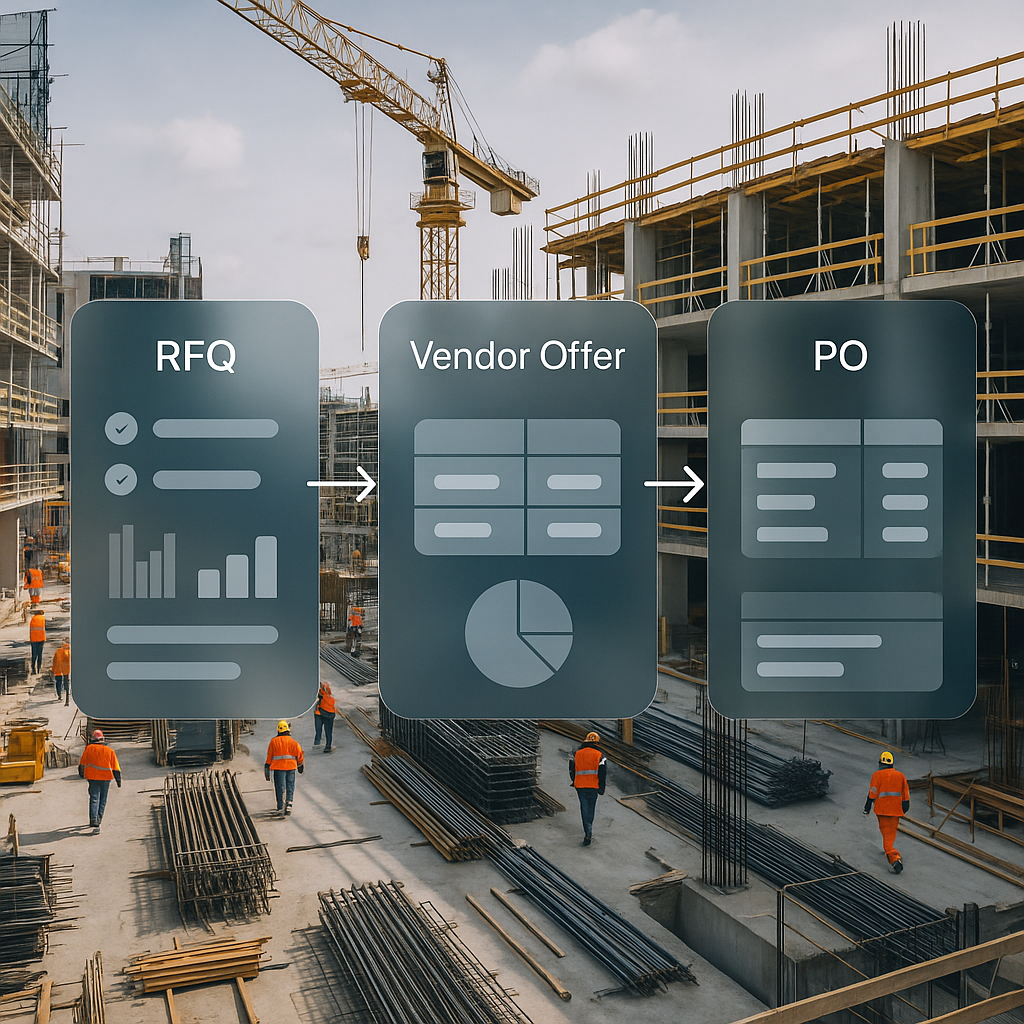
Every ₹10 Counts in Contracting—Until It Doesn't
Small contractors live and die by their margins. Yet, most are leaking cash in a place they rarely look—procurement. I've seen it happen over and over: a ₹4 lakh vendor payment gets delayed because someone “forgot” to approve the PO on time. Or worse, the same material gets ordered twice because two sites didn’t talk to each other. Sound familiar?
Procurement chaos is a silent killer for small contractors. It’s not just about inefficiency. It’s about the real financial impact of disorganized workflows—higher prices, penalties, and delayed projects. Let’s be honest, can you afford that?
Where Procurement Falls Apart
Here’s the typical flow for many small contractors:
- Material Requests: A site engineer sends a request for materials—usually on WhatsApp or email. There’s no standard format, and important details like quantities or specifications may be missing.
- Vendor Sourcing: The procurement head scrambles to source quotes from vendors, often relying on their phone contacts and past relationships.
- Approval Process: Approvals are either verbal or skipped altogether. Sometimes, materials are delivered before official approval.
- Purchase Orders (POs): POs are manually created, often after the material is already delivered, leading to mismatched documentation.
- Payment Tracking: Payments are tracked haphazardly using spreadsheets, creating confusion and delays.
This isn’t just chaotic—it’s expensive. Vendors start charging a “hassle premium” when they know you’re unorganized. You lose out on bulk discounts because your orders are fragmented. And let’s not even get started on the cost of errors (wrong materials, duplicate orders, late deliveries).
Concrete Example: A small contractor recently shared how they accidentally placed two separate orders for the same electrical components for two sites. This duplication cost them ₹1.2 lakh in wasted materials and vendor penalties because there was no coordination between the project managers. Multiply such incidents across multiple projects, and you’re bleeding money.
The Fix: Structured Procurement Workflows
A unified ERP can fix this mess, but let’s break it down practically. What does “structured procurement” even mean? It’s not rocket science—it’s about having a clear, enforceable process:
1. Material Request (MR):
- Use standardized forms (digital or paper) that capture exactly what’s needed: material name, quantity, specifications, and urgency.
- Ensure site engineers have easy access to these forms—preferably through a mobile app.
- Actionable Tip: Create a mandatory checklist for site engineers to fill before submitting an MR.
2. Request for Quotation (RFQ):
- Send RFQs to pre-approved vendors for competitive pricing. Use a system that automates this process and keeps all responses in one place.
- Example: A contractor who implemented an ERP reported that RFQs sent to 5 vendors instead of 2 led to savings of 15% per order, as vendors competed for the business.
3. Vendor Offers:
- Centralize all vendor quotes in a single dashboard. This avoids the headache of digging through emails.
- Compare pricing, lead times, and payment terms side by side.
- Actionable Tip: Develop a scoring system to rank vendor quotes based on price, reliability, and delivery time.
4. Purchase Order (PO):
- Generate POs automatically based on approved quotes. Ensure proper authorization workflows are in place to avoid unapproved purchases.
- Case Study: An HVAC contractor reduced their PO processing time by 60% by auto-generating POs through an ERP.
5. Goods Receipt & Payments:
- Link invoices and payments to the original PO. This ensures you only pay for what you received and eliminates duplicate payments.
- Actionable Tip: Set up automated reminders for pending vendor payments to avoid penalties.
When you enforce this flow, you eliminate the guesswork. No more “Did we order this?” or “Who approved this payment?” It’s all there—tracked and traceable.
Real-World Example: ₹25 Lakh Lost to Procurement Chaos
Take this example from JobNext’s blog. Contractors in India and GCC lose upwards of ₹25 lakh annually to manual procurement errors. That’s money you’ll never get back. And the smaller your company, the harder it hits—because you don’t have a massive cash reserve to absorb it.
A small HVAC contractor cited in the post fixed this by switching to a unified ERP. The result?
- Procurement delays reduced by 70%.
- Bulk orders unlocked better pricing.
- Duplicate POs and orders eliminated entirely.
The lesson is clear: structure pays for itself.
“But My Team Won’t Use It”
I get the skepticism. Contractors often tell me, “My guys aren’t tech-savvy” or “We’ve always done it this way.” Fair. But consider this: what’s the cost of doing nothing?
Overcoming Resistance
- Start Small: Begin with a pilot project. Pick one site or one process to digitize and scale gradually.
- Ease of Use: Choose a system that’s intuitive. Tools like ProjectsNext are mobile-friendly, so your site team can raise MRs on their phones.
- Training: Many ERP vendors offer onboarding and training support. Invest a few hours—it pays off in saved time and money later.
Example: A contractor in Pune rolled out an ERP only for procurement initially. Within 3 months, they saw such significant savings that the team was eager to expand it to other processes.
Comparison Table: Manual vs Structured Procurement
| Aspect | Manual Process | Structured Procurement (ERP) |
|---|---|---|
| Material Requests | WhatsApp, email | Standardized digital forms |
| Vendor Quotes | Scattered, hard to compare | Centralized dashboard |
| Approval Process | Verbal or skipped | Defined workflows with accountability |
| PO Generation | Manual, error-prone | Auto-generated, linked to approvals |
| Payment Tracking | Spreadsheets, prone to errors | Linked to POs and receipts |
FAQ
1. Isn’t an ERP too expensive for small contractors? Not anymore. With SaaS models, you pay a monthly fee per user, making it affordable even for small teams. Many vendors offer pricing as low as ₹2,000–₹5,000 per month.
2. How long does it take to implement? It depends on your team size, but many contractors see results within a few months. Start with procurement and expand as you see success.
3. What if my team isn’t tech-savvy? Modern ERPs like ProjectsNext are designed to be intuitive. Plus, vendors often provide training and support to get your team up to speed.
4. Can I integrate it with my current tools? Yes, many ERPs offer integrations with accounting software (e.g., Tally), payroll systems, and even project management tools.
5. What’s the ROI? Most contractors recoup their investment within 6–12 months through cost savings, bulk discounts, and improved efficiency.
The Bottom Line
If you’re still running procurement through emails and spreadsheets, you’re gambling with your margins. A unified ERP isn’t just a tech upgrade—it’s a survival tool for small contractors.
Stop letting disorganization cost you. ProjectsNext can help you take control of your procurement workflows—and protect your bottom line.
Learn more at JobNext.ai - Construction ERP