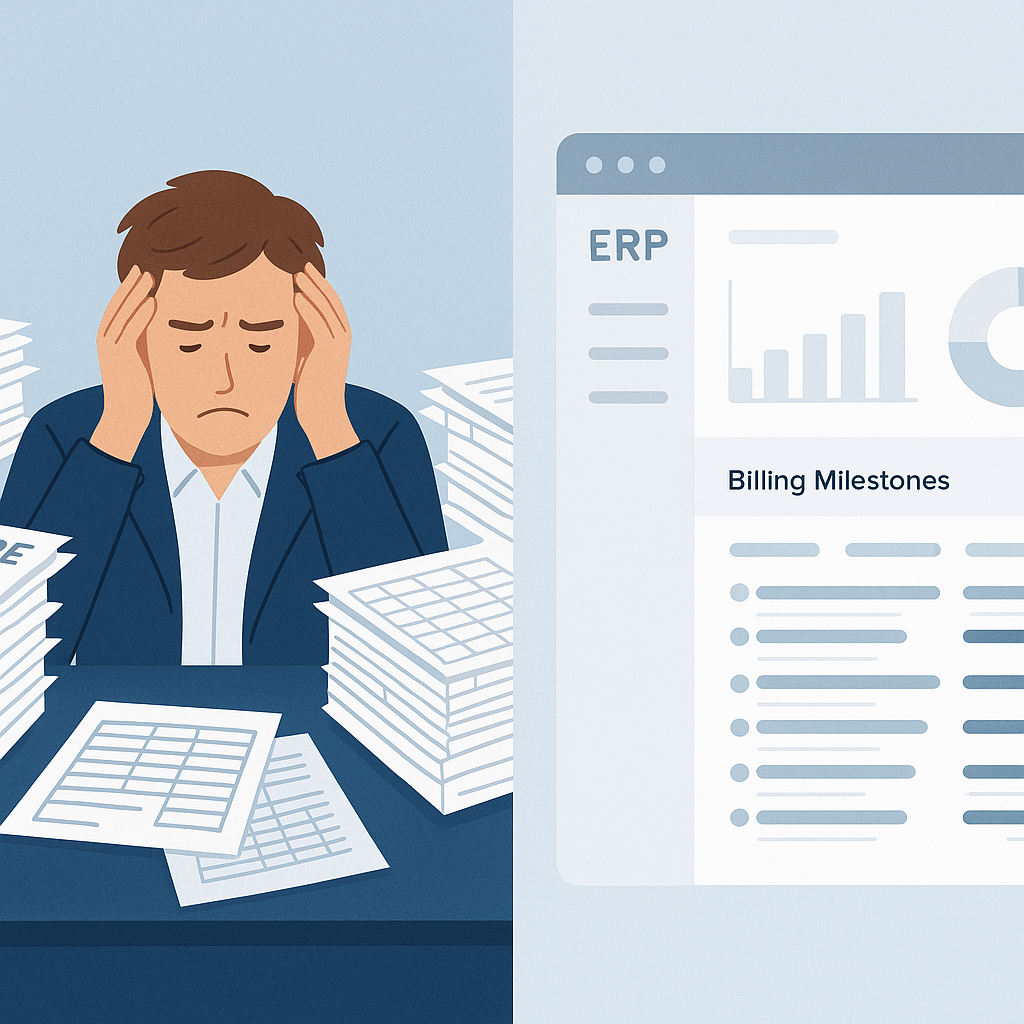
Subcontractor Costs Are Bleeding Your Margins — Here’s Why
Managing subcontractors is tricky. You issue work orders, track progress, and release payments. Sounds simple, right? It’s not. One missed measurement or an unverified invoice, and you’re either overpaying or delaying payments, both of which hurt your business.
In India and GCC, subcontractor overruns are a massive problem. I’ve seen companies lose as much as ₹50 lakh annually just because they didn’t have a proper system to track subcontractor work. And no, spreadsheets and WhatsApp groups don’t count as a system.
What’s the Real Problem?
Most contractors struggle with:
- No Real-Time Progress Tracking: You rely on site engineers to manually calculate progress and send updates. By the time it reaches accounts, it’s outdated or incomplete.
- Unverified Invoices: Subcontractors send invoices based on what they think is complete, not necessarily what’s measured.
- Payment Delays: Without clarity on progress, payments get stuck. This strains relationships and slows down work.
- Disconnected Tools: Your work requisitions, progress sheets, and payment approvals live in different tools (or worse, in nobody’s hands). Nothing talks to each other.
If any of this sounds familiar, you’re not alone. It’s a pain point for contractors of all sizes. But it hits smaller contractors harder because their margins are thinner.
Real-World Example: The ₹50 Lakh Leak
Let’s look at a common scenario. A mid-size civil contractor with 20 active subcontractors discovered they were losing ₹50 lakh annually. Why? Progress tracking was manual. Site engineers would measure work, jot it down on paper, and email it to accounts. Invoices from subcontractors often didn’t match these measurements, leading to overpayments. Worse, nobody could trace discrepancies because there was no central repository for data.
This isn’t a one-off story. Similar inefficiencies plague most contractors relying on fragmented systems.
The Fix: Measurement-Based Progress Tracking in ERPs
Unified construction ERPs, like JobNext, solve this by enforcing a measurement-based progress tracking system. Let me explain how it works in real life.
- Work Requisitions: Before any subcontractor starts, you issue a detailed work requisition (WR). This defines the scope, BOQ items, and expected timelines.
- Measurements: As work progresses, site engineers update measurement sheets directly in the ERP. These sheets are tied to specific BOQ items, so there’s no ambiguity.
- Progress Approvals: The system forces approvals at each stage. For example, a 40% payment won’t go through until the corresponding progress is verified.
- Auto-Reconciled Payments: Once progress is approved, the ERP auto-generates payment vouchers that match the exact completed work. No overpayments, no disputes.
This structured approach ensures you’re only paying for what’s done, not what the subcontractor claims is done. And because everything is in one platform, there’s no chasing emails or spreadsheets.
Actionable Steps to Implement Measurement-Based Progress Tracking
- Audit Your Current Process: Identify gaps in your subcontractor management. Are you manually tracking progress? Are invoices routinely disputed?
- Choose the Right ERP: Platforms like JobNext are designed for contractors. Look for features like BOQ integration, real-time updates, and payment reconciliation.
- Train Your Team: Ensure site engineers, project managers, and accounts teams understand how to use the system.
- Digitize Measurement Sheets: Replace paper or Excel sheets with ERP-based digital measurement tools.
- Monitor and Optimize: Regularly review ERP reports to spot inefficiencies or discrepancies.
Does It Really Work?
Yes. Here are two case studies:
Case Study 1: ₹35 Lakh Saved in UAE
A mid-size MEP contractor in the UAE was bleeding cash on subcontractor overruns. They implemented JobNext’s subcontractor management module. Within the first year:
- Savings: ₹35 lakh recovered through tighter progress tracking and payment reconciliation.
- Efficiency: Reduced the time spent on progress approvals by 60%.
- Transparency: Site engineers, accounts, and project managers had real-time access to the same data.
Case Study 2: 80% Fewer Disputes in India
A civil contractor in India faced constant disputes with subcontractors. They moved to a measurement-based ERP system. The results?
- Disputes reduced by 80% because all progress was documented.
- Payments streamlined, improving subcontractor satisfaction.
- Better forecasting, leading to smoother cash flow management.
Why Spreadsheets Can’t Compete
You might think, “Why not just use Excel?” Here’s why that doesn’t work:
- Manual Errors: Humans make mistakes. A single typo in a formula can cost lakhs.
- No Audit Trail: Spreadsheets don’t track who changed what and when. ERPs do.
- No Integration: Spreadsheets don’t talk to your finance or procurement systems. ERPs unify everything.
- Scalability: Managing 5-10 subcontractors on Excel is doable (barely). Managing 50? Impossible.
Comparison Table: Spreadsheets vs. ERPs
| Feature | Spreadsheets | ERPs like JobNext |
|---|---|---|
| Error Prevention | High risk of manual errors | Automated and validated |
| Audit Trail | None | Complete change logs |
| Integration | Manual data syncing | Unified with other systems |
| Scalability | Limited | Unlimited |
| Real-Time Updates | Not possible | Available |
| Compliance Management | Manual | Automated |
How JobNext Helps
JobNext’s subcontractor management module is built for this exact problem. Here’s what it does:
- Work Requisitions: Create and track WRs with detailed BOQ and scope definitions.
- Measurement Sheets: Digitally update progress, tied to specific BOQ items.
- Payment Controls: Link payments to verified progress, ensuring you never overpay.
- Compliance Built-In: GST/TDS compliance is automated, so you don’t miss filings.
Everything flows seamlessly from site to finance. And because it’s all in one platform, you get real-time visibility into subcontractor costs and progress.
FAQ
1. What size contractors benefit from unified ERPs?
Small to mid-size contractors managing 5+ concurrent projects benefit the most. Larger contractors already use ERPs.
2. How much does an ERP typically cost?
Costs vary, but most cloud-based ERPs (like JobNext) use a subscription model. Expect to pay per user, per month. For example, pricing can range between ₹1,000 to ₹3,000 per user monthly.
3. Can ERPs handle GST compliance?
Yes. JobNext, for example, automates GST/TDS calculations and integrates with Tally for statutory filings.
4. How long does ERP implementation take?
Anywhere from 1-3 months, depending on the size of your team and number of modules you implement.
5. What if my subcontractors don’t use tech?
No problem. Site engineers can handle the measurements and updates. Subcontractors just need to focus on their work.
Final Thoughts
Subcontractor overruns aren’t just a cost problem. They’re a cash flow and relationship problem too. If you’re still relying on spreadsheets or disconnected tools, you’re leaving money on the table. Unified ERPs like JobNext fix this by bringing structure and accountability to subcontractor management.
Want to see how it works? Get started free →