Manual Procurement Isn’t Just a Mess — It’s Costing You ₹25 Lakh a Year
Procurement is messy. At least, that’s what we hear from contractors all the time. Material requisitions (MRs) get lost in email threads, RFQs are delayed, vendor quotes come in scattered formats, and purchase orders (POs) take forever to finalize. If you’re running multiple projects, the chaos multiplies.
And the cost? Brutal. Small contractors in India and GCC lose up to ₹25 lakh annually because of procurement delays and errors. If you’re wondering how, let me break it down:
- Missed deadlines: Late POs mean delayed material deliveries, which cascade into stalled project timelines.
- Vendor price hikes: Slow RFQ processes give vendors room to revise quotes upward while you scramble.
- Duplicate orders: Without a structured workflow, teams accidentally reorder materials — wasting money.
Why Small Contractors Struggle
The obvious question: Why is this so common among smaller firms? It’s not because of incompetence. It’s because many rely on disconnected systems or manual processes. Excel, WhatsApp, and email might seem “good enough,” but they aren’t built for scale. They’re error-prone and painfully slow.
A Closer Look at the Bottlenecks
Take MR approvals as an example. In manual workflows, approvals get stuck in bottlenecks — waiting for site managers to send data, procurement heads to review, and finance teams to sign off. By the time the PO is finalized, the material is already overdue.
Here’s a real-world story: A mid-sized contractor in Bangalore managing five concurrent projects found that it took an average of 10 days to move an MR from initiation to approval. In one instance, this delay caused a critical shortage of rebar, halting construction for a week and leading to a ₹7 lakh penalty for missed milestones. These inefficiencies aren’t rare — they’re the norm.
Another major issue is vendor communication. Without centralized systems, RFQs often remain scattered across email inboxes. Vendors respond at their convenience, and procurement teams lose valuable time chasing responses. A Kolkata-based contractor reported losing ₹3 lakh in discounts because they failed to meet a vendor's early-payment deadline — all because the PO approval process dragged on for days.
The Fix: Unified Procurement Workflows
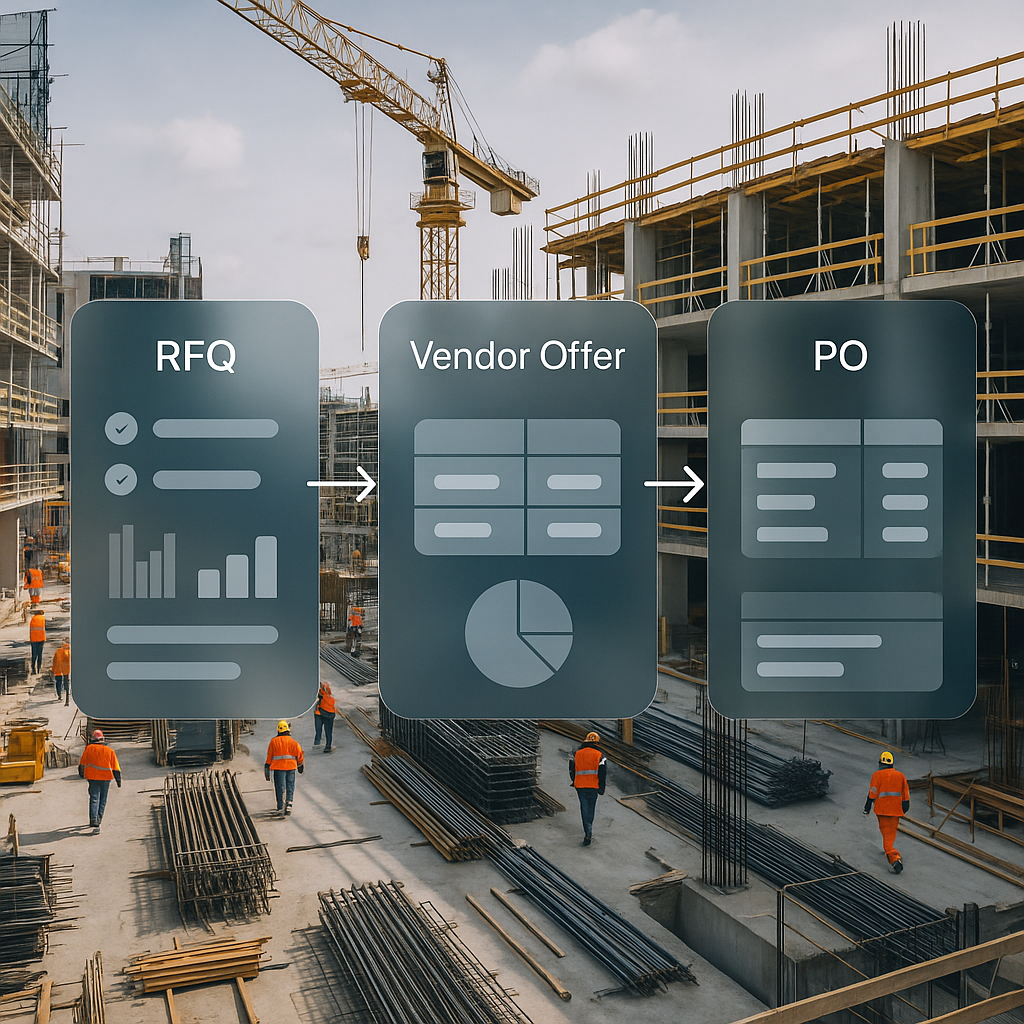
Here’s where unified construction ERP systems shine. Instead of juggling five tools, everything runs on one platform. For procurement, it means structured workflows:
- Material Requisitions (MRs): Site teams raise MRs directly in the ERP, tagging them to specific BOQs and project scopes.
- RFQs: Procurement heads issue RFQs to pre-approved vendors within minutes — no manual follow-ups.
- Vendor Offers: All quotes are automatically compared side-by-side, with clear visibility into pricing, lead times, and vendor ratings.
- Purchase Orders (POs): Finance teams approve POs based on real-time budget tracking and compliance checks.
Case Study: A Contractor’s Turnaround
One of our clients, a small contractor in the GCC, implemented a unified ERP system after years of struggling with manual procurement. Before the ERP, their average PO approval time was 8 days. After switching, they reduced it to just 2 days. Over the course of a year, this improvement alone saved them ₹18 lakh in reduced penalties and vendor cost escalations. Additionally, the system flagged duplicate MRs, saving another ₹4 lakh in wasted material orders.
Actionable Steps to Streamline Procurement
If you’re still relying on manual systems, here’s how to start fixing your procurement:
-
Audit Your Current Workflow: Map out every step in your procurement process. Identify bottlenecks — whether it’s MR approvals taking too long or RFQ responses getting delayed.
-
Standardize Communication: Create templates for RFQs, POs, and vendor communications. Ensure everyone on your team follows the same process.
-
Digitize Approvals: Even if you’re not ready for a full ERP, start with digital tools like Google Forms or Trello to track and manage approvals.
-
Build a Vendor Database: Maintain a centralized list of pre-approved vendors with updated contact information, pricing, and performance history.
-
Evaluate ERP Options: If your team is regularly dealing with delays or errors, it’s time to consider an ERP. Look for platforms that cater specifically to small contractors, like ProjectsNext.
Don’t Believe Me? Here’s the Math
Let’s say your firm loses ₹2 lakh per delayed PO on average, across 12 projects annually. That’s ₹24 lakh gone. Add duplicate orders, vendor price hikes, and missed discounts — you’re easily crossing ₹25 lakh in avoidable costs.
Unified ERPs don’t just save time. They save money. By eliminating delays, automating vendor comparisons, and enforcing approval workflows, you stop bleeding margins. It’s not magic, just common sense.
A Simple ROI Calculation
- ERP Investment: ₹5 lakh annually for a subscription.
- Savings: ₹25 lakh recovered from reduced delays, errors, and inefficiencies.
- Net ROI: ₹20 lakh saved every year.
The math doesn’t lie. For every ₹1 you spend, you’re saving ₹5 or more.
What About Skeptics?
You might be thinking: “Sounds great, but ERPs are expensive.” True, they’re an investment. But the ROI is undeniable. For every ₹1 you spend on an ERP, you’re saving ₹10 in avoided mistakes and improved efficiency. And modern SaaS platforms like ProjectsNext are designed for small contractors — scalable pricing, easy onboarding, and zero IT headaches.
Don’t take my word for it. According to ₹25 Lakh Lost to Procurement Chaos? Why Contractors Need Data Integration, contractors who adopt integrated systems see significant margin recovery. It’s not optional anymore — it’s survival.
Comparison Table: Manual Procurement vs Unified ERP System
| Feature | Manual Process | Unified ERP System |
|---|---|---|
| Material Requisition | Email/WhatsApp | Centralized, tagged to BOQs |
| RFQ Process | Scattered, slow | Automated, pre-approved list |
| Vendor Comparisons | Manual spreadsheets | Auto-generated comparisons |
| Purchase Orders | Delayed approvals | Real-time tracking |
| Budget Tracking | Difficult, reactive | Real-time, proactive |
| Cost of Errors | High | Minimal |
FAQ
Q: How does an ERP handle vendor comparisons? A: Vendor quotes are uploaded directly into the system, where they’re auto-compared on pricing, lead time, and past performance. No manual spreadsheets.
Q: Does it require IT expertise to use? A: Not at all. Platforms like ProjectsNext are SaaS-based and user-friendly. Training takes days, not months.
Q: Can it track procurement budgets across multiple projects? A: Yes. Unified ERPs provide real-time budget tracking at the project and company level, ensuring procurement stays within limits.
Q: What if I already use Tally for finances? A: Many construction ERPs integrate seamlessly with Tally for statutory compliance and reporting. No need to abandon your existing tools.
Q: Is it worth the cost for small contractors? A: Absolutely. Between recovered margins, faster workflows, and reduced errors, the savings far outweigh the expense.
If you’re dealing with manual procurement chaos, ProjectsNext can help. Get started free →
Learn more at JobNext.ai - Construction ERP