You’re Losing Money Without Knowing It
Most small contractors think they’re saving money by sticking to spreadsheets, WhatsApp approvals, and a mix of disconnected tools. It feels lean, right? No big software expenses, no time wasted on implementation? But here’s the truth: those ‘savings’ are costing you big.
Take procurement, for example. It’s chaotic for most contractors. A site engineer raises a material request (MR) via email or a phone call. Someone in the back office scrambles to get vendor quotes. Approval? Maybe a quick WhatsApp message. By the time you issue a purchase order (PO), prices have changed, or worse, the wrong material gets delivered. You’ve just blown your margins.
A unified ERP eliminates this mess entirely. Let’s look at how.
Real Procurement Workflow, Simplified
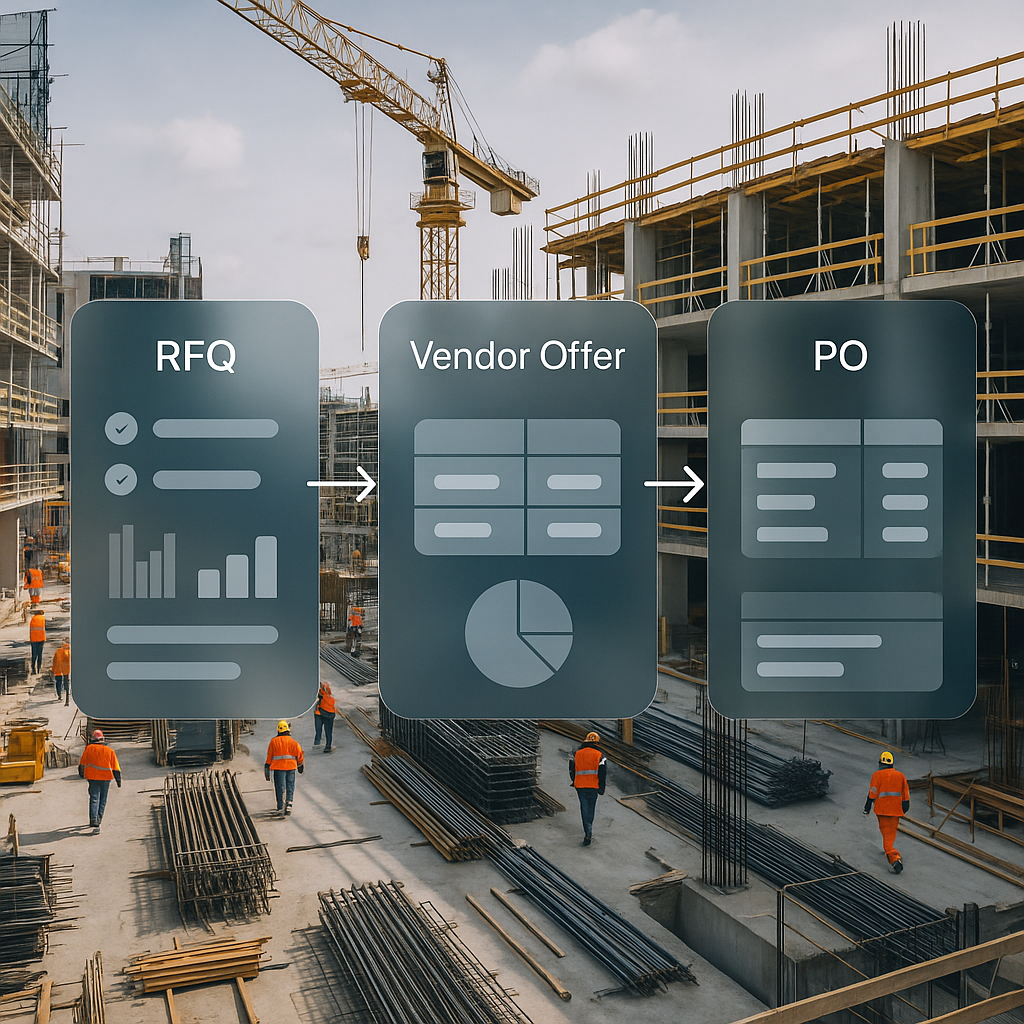
Here’s what happens inside an ERP like JobNext. A site engineer raises an MR directly in the system. It’s tied to the specific BOQ line item for that project, so quantities and specs are already clear. The MR automatically triggers a structured RFQ (Request for Quotation) process. Vendors respond, and their offers are logged directly in the system for comparison. Once the best offer is selected, the system generates a PO — no manual re-entry, no errors.
And approvals? Fully customizable workflows. Need the Operations Head to approve MRs over ₹50,000? Done. Want the Finance Controller to sign off on POs for non-budgeted items? Easy. It’s all tracked, with timestamps and audit trails.
Why does this matter? Because every delay, every miscommunication, every missed approval eats into your profit. With a unified ERP, you’re not just faster — you’re precise.
The GST Compliance Headache
Another silent killer for small contractors is compliance. Especially GST. If you’re juggling multiple sites, vendors, and invoices, filing accurate GST returns is a nightmare. Miss a deadline or make an error, and penalties start piling up.
A good construction ERP handles this for you. For example, JobNext automatically links your POs, vendor invoices, and project expenses to GST categories. It even integrates with Tally for statutory reporting in India. You’ll know exactly what’s payable, what’s claimable, and when.
What’s the Obvious Objection?
“You might be thinking: ERPs are for big players. We’re too small for this.”
But here’s the thing — the smaller your margins, the more you need control. A ₹10,000 mistake on a ₹1 crore project is 1%. If your profit margin is 8%, you just lost 12.5% of your earnings on one error. An ERP doesn’t just pay for itself; it protects your bottom line.
Start Small, Scale Smart
You don’t have to roll out an ERP across your entire company overnight. Start with one module. Procurement is a great place to begin because the ROI is immediate. Once you see the impact, it’s easy to add project tracking, billing, or HR.
Tools like JobNext are built for contractors like you — small to mid-size, running multiple projects, and needing real-time visibility. You’re not just buying software; you’re buying peace of mind.
So, ditch the chaos. Your margins will thank you.
Want to see how JobNext handles procurement workflows? Request a Demo Today.
Ready to see JobNext in action?
Multi-tenant SaaS ERP for construction, facilities management, and contracting — covering preconstruction, project execution, procurement, HR & payroll, equipment, finance, and 150+ analytics reports.
Get Started Free →Learn more at JobNext.ai - Construction ERP