₹1.2 Crore Lost to Disconnected Procurement Workflows
If you're a contractor managing multiple projects, you've probably felt the pain of procurement chaos. A material request (MR) gets raised, but no one tracks it properly. Vendors delay quotes. Purchase orders (POs) sit in approval limbo. Meanwhile, your site is stalled, and the client deadline looms. Sound familiar?
This isn't just annoying; it's expensive. Disconnected workflows in procurement can cost small contractors up to ₹1.2 crore annually in delays, idle labor, and missed deadlines. JobNext.ai recently highlighted how procurement inefficiencies erode margins. The math is brutal: every stalled day means paying salaries for idle workers, penalty charges for delay, and scrambling for last-minute material at inflated prices.
What Does ₹1.2 Crore in Losses Look Like?
Let’s break this down:
- Idle Labor Costs: Suppose you run a team of 50 workers with an average daily wage of ₹800. A stalled project for just 10 days costs you ₹4,00,000 in wages for workers who aren’t producing any output.
- Delayed Completion Penalties: Many contracts impose penalties for missing deadlines. These can range from 0.5% to 1% of the project value per week. For a ₹5 crore project delayed by two weeks, you could owe ₹5,00,000.
- Material Cost Inflation: Last-minute procurement means overpaying for materials. A steel supplier might hike prices by 10% when you need urgent delivery. If your steel budget was ₹50,00,000, this adds ₹5,00,000 to your costs.
Suddenly, ₹1.2 crore doesn’t seem like an exaggeration — it’s a realistic estimate of what inefficiencies can drain from your bottom line.
Why Unified ERPs Are the Fix
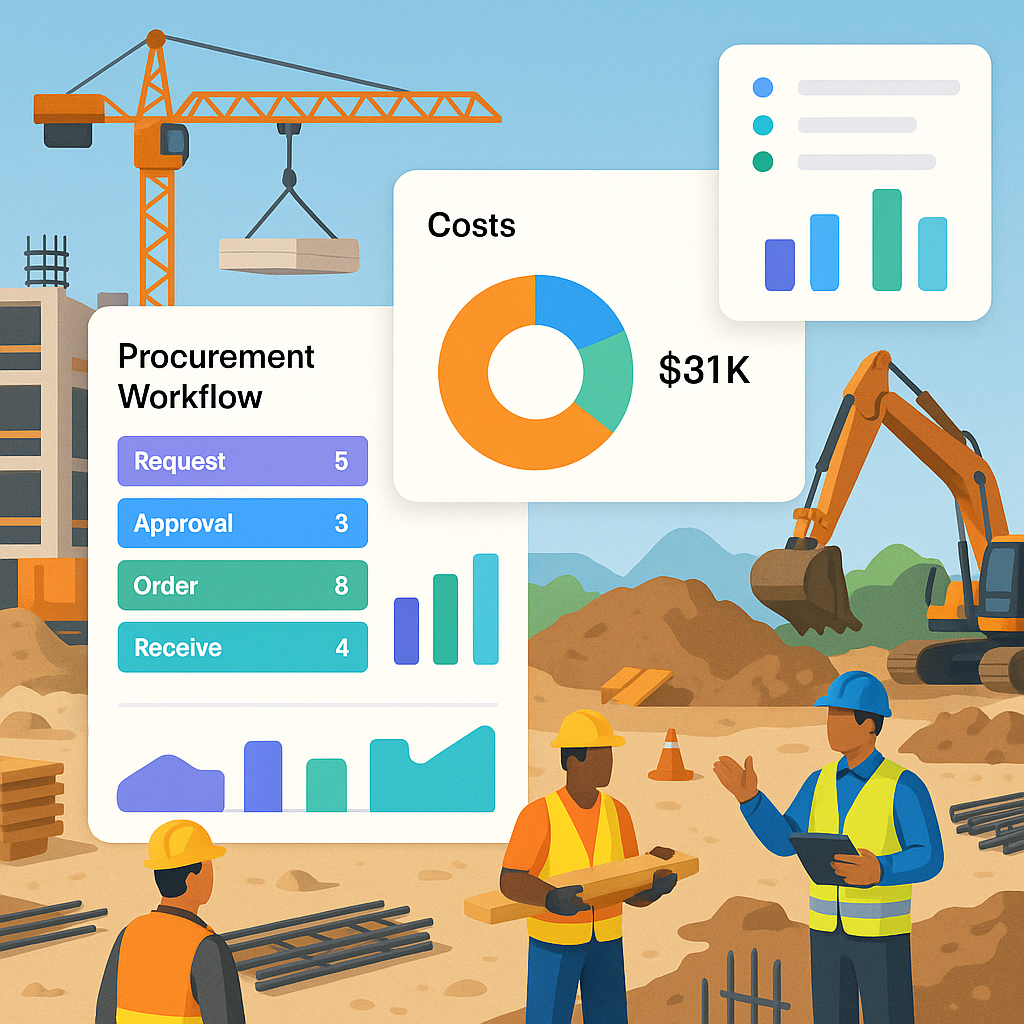
A unified ERP system, like ProjectsNext, solves this by connecting every step of procurement into one structured workflow. Here's what it looks like:
- Material Request (MR): Site teams raise requests directly in the ERP. No lost emails or WhatsApp messages.
- RFQ Generation: The system automatically creates request-for-quotations (RFQs) and sends them to approved vendors.
- Vendor Offers: Offers are logged in the ERP, allowing procurement managers to compare prices in one view.
- Approval Workflow: Multi-level workflows ensure POs are approved faster, with full visibility into who approved what.
- Purchase Order (PO): Once approved, the PO is issued directly from the system, with tracking for delivery timelines.
Case Study: How a Mid-Sized Contractor Saved ₹75 Lakhs
A Pune-based contractor managing four simultaneous projects implemented ProjectsNext. Previously, they relied on spreadsheets and manual approvals, which caused delays. After adopting the ERP:
- Material procurement lead times were reduced by 30%, saving ₹20 lakhs in idle labor and penalties.
- Vendor negotiations improved, cutting material costs by ₹15 lakhs.
- Compliance reporting errors dropped to zero, avoiding ₹5 lakhs in penalties.
In their first year, the contractor saved ₹75 lakhs — a clear ROI from their ERP investment.
The Compliance Angle: GST, TDS, and More
Disconnected procurement isn't just costing you time; it could also land you in compliance trouble. In India, GST and TDS reporting are mandatory for contractors, and mistakes can lead to hefty fines. Unified ERPs like ProjectsNext simplify this by auto-calculating taxes and integrating with accounting tools like Tally.
Real Example: GST Errors
In 2022, a Delhi contractor was fined ₹2 lakhs for late GST filings linked to procurement delays. The issue? Their manual process meant invoices were misplaced, and GST wasn’t calculated on time. With an ERP, GST tracking is automatic, ensuring compliance with deadlines.
For small contractors in the GCC, compliance challenges include multi-currency transactions and VAT reporting. A well-designed ERP handles all of this, ensuring you're audit-ready without endless spreadsheets.
Real-Time Cost Tracking: The Margin Saver
One of the biggest benefits of unified ERPs is real-time cost tracking. With every MR, RFQ, PO, and invoice logged in the system, you get a live view of your project expenses against estimates. This means no surprises when you calculate profitability.
Actionable Tips for Better Cost Management:
- Centralize Your BOQs: Upload your bill of quantities (BOQs) into the ERP. This creates a baseline for tracking expenses.
- Use Alerts: Set automated alerts for when you exceed 90% of your budget in any category.
- Compare Real vs. Estimated Costs: Use the ERP’s reporting tools to analyze variances in real-time.
JobNext.ai explains why contractors without real-time tracking are bleeding margins. If you're still relying on Excel to track project costs, you're losing money. Unified ERPs fix this by automating cost tracking across BOQs, scopes, and estimates.
Why Small Contractors Can't Ignore This
You might be thinking: "I don't have the budget for an ERP." But here's the thing — the cost of not having one is higher. Idle labor, delayed projects, rushed procurement, and compliance penalties add up fast. Even for small contractors, the ROI of a unified ERP is clear.
Example: The ₹3 Lakhs ERP vs. ₹12 Lakhs in Losses
A small contractor in Bangalore debated whether to invest ₹3 lakhs annually in an ERP. They decided against it — and ended up losing ₹12 lakhs that year due to stalled projects and penalties. The following year, they implemented the ERP, and within six months, they saw a 4x return on their investment.
Subcontractor Overruns
Subcontractor overruns are another silent killer for margins. Without measurement-based progress tracking, payments spiral out of control. Unified ERPs solve this by tracking subcontractor progress against work orders. JobNext.ai's blog details how manual tracking costs contractors ₹1.2 crore annually. The fix? A system that ties measurements to payments.
Decision Framework: Should You Invest in an ERP?
| Factor | No ERP | With ERP |
|---|---|---|
| Procurement lead time | Delays of 2-4 weeks | Reduced by 30-50% |
| Cost tracking | Manual, prone to errors | Automated, real-time |
| Compliance | Risk of penalties, manual errors | Automated reporting |
| Vendor management | Limited visibility | Centralized, comparative |
| ROI | Losses of ₹1 crore+ annually | Savings ₹75 lakhs+ |
FAQ
Q: What if my team isn't tech-savvy?
A: Choose an ERP with an intuitive interface and strong training support. Many systems offer onboarding programs to help teams get up to speed quickly. Some companies even provide 24/7 customer support to answer questions as your team adapts.
Q: How do I justify the cost of an ERP?
A: Calculate what you're losing in delays, compliance fines, and margin erosion. For example, add up the costs of idle labor, penalties, and overspending on materials for the past year. Compare this to the cost of an ERP subscription — the savings usually far outweigh the expense.
Q: Will an ERP work for contractors with fewer than 50 employees?
A: Yes, many ERPs are scalable for smaller teams. Look for systems designed specifically for small contractors. These often have lower pricing tiers and features tailored to your needs.
Q: How long does it take to implement an ERP?
A: Implementation timelines vary, but many systems can be up and running in 4-6 weeks. During this time, ensure your team is trained and ready to adopt the new workflows.
Q: What features should I prioritize in an ERP?
A: Focus on procurement workflows, real-time cost tracking, and compliance tools. If you manage multiple projects, look for project management features like Gantt charts and resource allocation tools.
Bottom Line: It's Not Just Software
Unified ERPs aren't just about automating workflows; they're about saving your margins. Every feature — from procurement workflows to real-time cost tracking — addresses the specific pain points small contractors face.
But here's the catch: software alone won't fix everything. As JobNext.ai points out, ERP success depends on people. Your team needs buy-in and training to make the system work.
Call to Action
If you're dealing with procurement chaos, compliance headaches, or margin erosion, ProjectsNext can help. Get started free →
Learn more at JobNext.ai - Construction ERP