
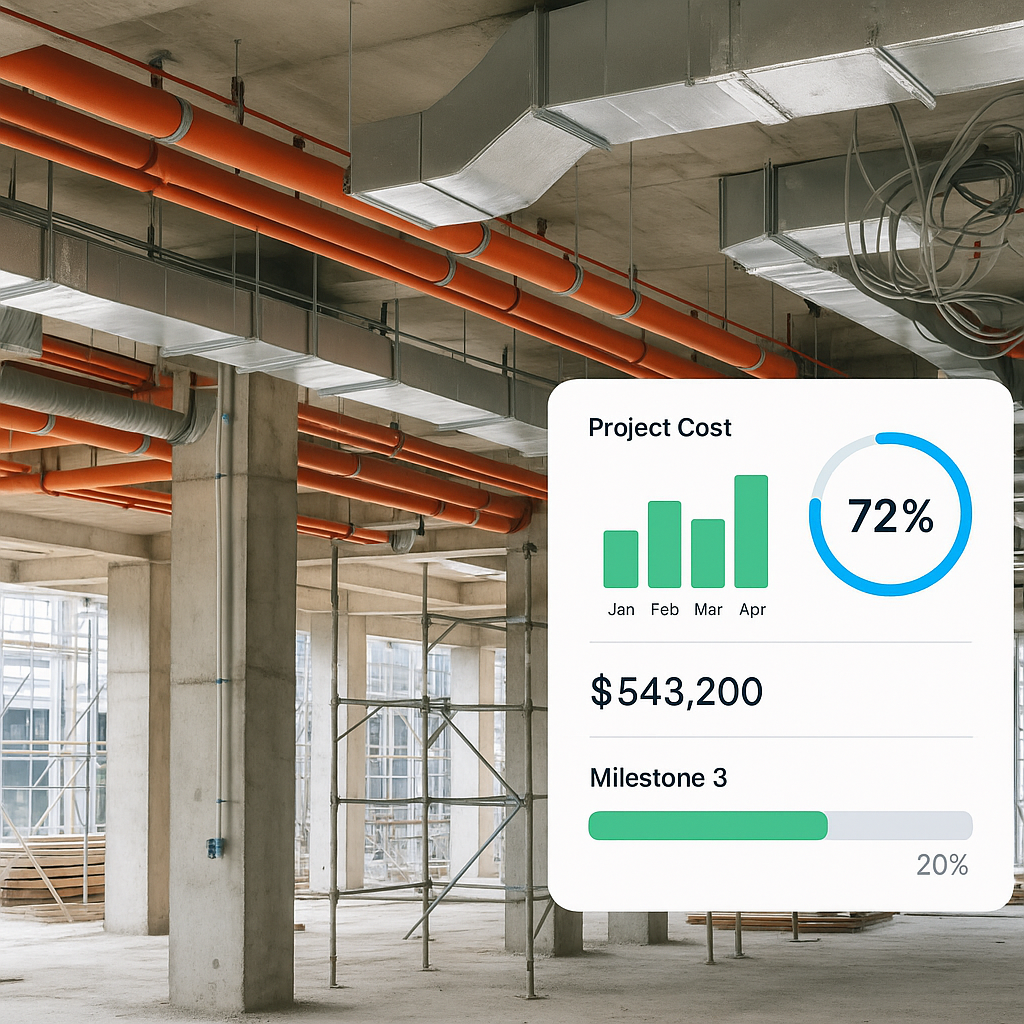
The Real Cost of MEP Project Overruns
You’ve been there before: the project starts strong, but somewhere along the way, costs spiral out of control. Suddenly, your margins are slashed, and you’re left scrambling to figure out what went wrong. For MEP (Mechanical, Electrical, and Plumbing) contractors, this story is all too familiar.
Why? Because MEP projects are inherently complex. Multiple trades working in parallel, tight schedules, resource dependencies, and variable material costs make it a perfect storm for cost overruns. Add in manual processes, disconnected systems, and a lack of real-time data, and you’ve got a recipe for chaos.
But here’s the good news: this is a solvable problem. The right MEP contracting software can help you control costs and streamline workflows. Let’s break it down.
Problem 1: Margin Erosion from Poor Cost Tracking
Here’s a scenario: You’ve just completed the rough-in phase of an HVAC installation. The numbers you initially estimated for labor and materials seemed solid. But when you finally reconcile your costs at the end of the phase, you realize you’ve overshot the budget. Why? Because there was no mechanism to track actual costs in real-time.
Why Poor Cost Tracking Happens
- Manual Entry Errors: Many contractors still rely on spreadsheets or handwritten logs, which are prone to human error.
- Delayed Data Updates: Subcontractors and procurement teams often work in silos, leading to outdated or incomplete cost data.
- Scope Creep: Unapproved changes to the scope of work can inflate costs without being flagged in time.
How MEP Software Solves This
This is where MEP software like ProjectsNext shines. Many teams I’ve worked with find that real-time project profitability tracking is critical. Instead of waiting until the end of a phase (or worse, the entire project), you can monitor costs against your BOQ (Bill of Quantities) and scope continuously.
Actionable Steps to Improve Cost Tracking:
- Enable Real-Time Monitoring: Use software to sync on-site updates with your budget dashboard. This ensures that every purchase, time log, or material usage is reflected immediately.
- Set Automated Alerts: Configure alerts for cost overruns, such as when material usage exceeds the BOQ or when hours logged exceed labor estimates.
- Reconcile Weekly, Not Monthly: Conduct weekly reviews of your budget to catch issues early, rather than waiting for end-of-month reconciliations.
For example, the system can flag when material usage exceeds projected quantities or when unapproved work starts creeping in. At that point, you can make adjustments—whether it’s renegotiating with a vendor, reallocating labor, or revisiting the schedule to avoid delays. Catching issues early reduces surprises later.
If you’re curious about how structured procurement can also protect margins, check out our guide on How Procurement Workflows Can Save Margins in Construction. The principles apply equally to MEP contractors.
Problem 2: Disconnected Systems = Project Chaos
A lot of MEP contractors still rely on spreadsheets, emails, and disconnected tools to manage projects. This creates silos. Procurement doesn’t know what’s happening on-site. Finance doesn’t know what’s been invoiced. Operations is chasing down RFIs. Sound familiar?
The Hidden Costs of Disconnected Systems
- Time Wastage: Teams spend hours reconciling data between tools.
- Missed Deadlines: Delays in approvals or communication lead to schedule overruns.
- Data Duplication: Errors multiply when the same information is entered in multiple systems.
How ERP Systems Help
A unified ERP (Enterprise Resource Planning) system built for MEP contractors can eliminate these silos. With ProjectsNext, for instance, you get a single platform that spans tendering, procurement, subcontractor management, and billing.
Example Workflow with ERP:
Imagine you’re managing the electrical scope of a commercial building project. You’ve issued an RFQ (Request for Quotation) for cable trays. The vendor offers come in, but they’re all over the place in terms of price and delivery timelines. With disconnected tools, you’d need to manually compare these offers, which is both time-consuming and error-prone.
Now, if you’re using an ERP:
- The software automatically generates a comparative statement, highlighting the best option based on your criteria (e.g., lowest total cost, fastest delivery).
- Once approved, the system pushes the Purchase Order (PO) to the vendor and updates your procurement and financial modules instantly.
- Procurement, on-site teams, and finance are all updated in real-time, eliminating manual back-and-forth.
Key Features to Look for in an ERP:
- Centralized Data: All project details, from RFQs to billing, should reside in one system.
- Vendor Evaluation Tools: Built-in scoring for vendors based on cost, delivery times, and past performance.
- Real-Time Sync: Ensure updates are propagated instantly across teams.
For more on structured vendor evaluation, this post is worth a read.
Problem 3: Billing Gaps Lead to Revenue Leakage
Here’s something I see all the time: contractors underestimate the complexity of billing for MEP projects. Whether it’s RA (Running Account) bills, stage-wise billing, or monthly invoicing, it’s easy for items to slip through the cracks. And let’s not even talk about keeping track of retention amounts or variations.
Why Billing Gaps Happen:
- Missed Variations: Change orders or variations are often poorly documented.
- Manual Calculations: Progress-based billing often requires manual percent-completion calculations, which are prone to errors.
- Retention Tracking: Retention amounts are frequently overlooked or not invoiced on time.
How MEP Software Simplifies Billing:
MEP contracting software can simplify this. Take the 6 billing methods supported by ProjectsNext. Using a structured approach, you can ensure that every billable item—materials, labor, variations, etc.—is captured.
Actionable Steps for Better Billing:
- Automate Progress Calculations: Use software to calculate progress percentages for stage-wise billing.
- Standardize Retention Tracking: Set up automatic reminders for retention releases.
- Log All Variations: Document change orders in the system so they’re automatically added to invoices.
For example, for stage-wise billing, the system automatically calculates progress percentages based on completed activities, so you’re not scrambling to justify invoices at the end of the month.
FAQ: Common Questions About MEP Contracting Software
1. Will this software work for smaller MEP contractors?
Yes. Many solutions are scalable, meaning you can start small and add more modules as your needs grow.
2. How does this help with compliance?
For Indian contractors, features like GST/TDS compliance and Tally integration are critical. For GCC firms, payroll compliance with WPS (Wages Protection System) is often built-in.
3. What about training my team?
Most platforms offer onboarding support. Plus, many modern ERPs have intuitive UIs, so training isn’t as daunting as it used to be.
4. Can I integrate this with other tools?
Good ERPs like ProjectsNext often come with APIs or native integrations. For example, integration with Tally for statutory reporting is a common need in India.
5. How do I justify the cost of software to stakeholders?
Highlight the cost savings from reduced overruns, better margins, and minimized revenue leakage. Many providers also offer ROI calculators to make your case.
Comparison Table: Do You Need an MEP-Specific ERP?
| Feature | Generic ERP | MEP-Specific ERP (e.g., ProjectsNext) |
|---|---|---|
| Real-Time Cost Tracking | Limited or Customizable | Built-In |
| Vendor Evaluation | Basic | Advanced, Specific to MEP |
| Progress-Based Billing | Manual | Automated |
| Retention/Variation Tracking | Add-Ons Needed | Native Support |
| Industry-Specific Compliance | No | Yes |
Call to Action
If you’re tired of chasing costs, dealing with disconnected systems, and losing revenue to billing errors, it’s time to consider an MEP contracting software. ProjectsNext offers the tools you need to manage projects, control costs, and protect your margins—all in one platform. Get started with ProjectsNext →
Learn more at JobNext.ai - Construction ERP